
An enduring love for the Murchison
This story has been written from our podcast episode with Meg – if you’d like to hear her story in her voice, you can find the episode on Apple, Spotify, or here.
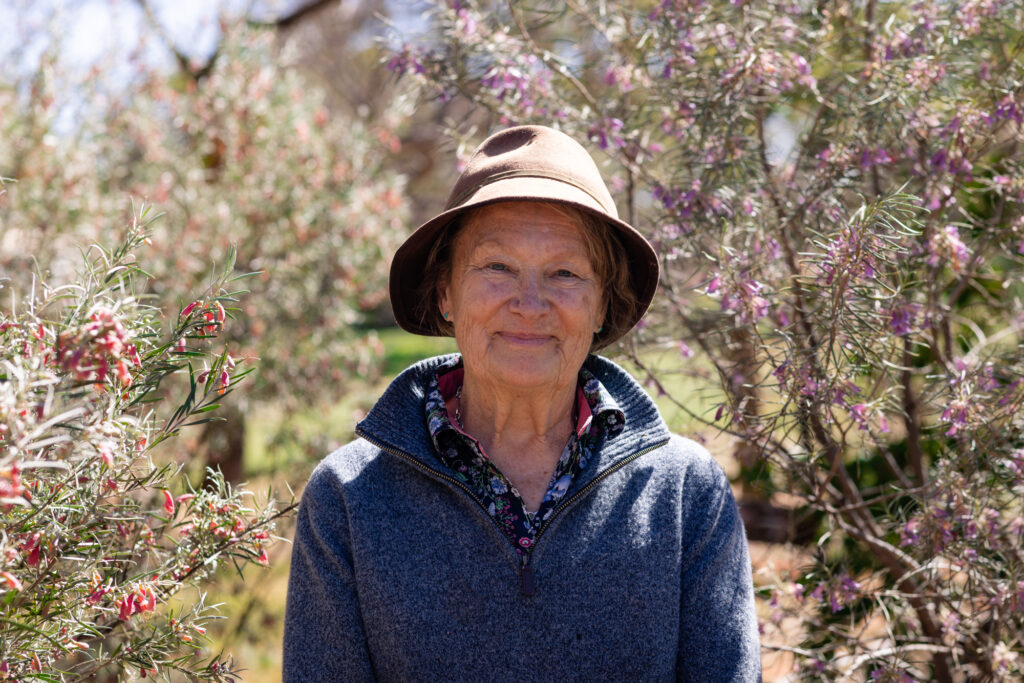
Meg Officer came to Western Australia from Scotland on a six-month working holiday in 1969. More than six decades later, the Murchison remains the place she calls home.
At around 10 years old, Meg Officer would follow an old shepherd in Scotland, watching him tend his sheep and help with lambing. She remembers being allowed to tag along, although she suspects the shepherd never said much to her.
“I developed a love of sheep right back then, I think. And it was fascinating.”
It was an unlikely beginning to a life that would take her from the green, wet landscapes of Scotland to the vast rangelands of Western Australia’s Murchison region, where she would raise a family, run a sheep station and develop a deep understanding of the native plants that grow across the country.
When Meg left Scotland in 1969, she had no idea what a sheep station really was. She had been studying in France and was considering university back in the United Kingdom when the desire to travel took hold.
Her parents agreed she could go to Australia, provided she had a job waiting for her. An advertisement for a position as a home help on a Western Australian sheep station caught her attention.
“Western Australian Sheep Station, Home Help, Varied Duties, sounds great. Twenty dollars a week plus keep.”
She was about 19, despite the advertisement specifying applicants over 21. Nevertheless, she secured the position and sailed for Australia, arriving in Fremantle on 8 February 1969.
The following day, she began the journey inland to Yuin Station.
After a seven-hour drive in an old Fiat station wagon, Meg arrived at a homestead surrounded by a large garden and bustling with workers.
The landscape was a world away from what she knew.
“I realized that it wasn’t grasslands, it was scrub. And the trees went much higher than 12-foot high.”
Her job involved cooking, cleaning, gardening, watering and helping care for three young children. She was quickly welcomed into the family, joining picnics and learning about life on a remote pastoral property.
She credits that first experience with helping her develop the affection for the Australian bush that would stay with her.
“Everything was explained to me and I could feel their deep love of the bush. And I think that helped me love it forever after.”
Among those who welcomed Meg was one of the owners, Jano, a woman with a reputation for matchmaking. Jano had a particular candidate in mind: Ted, who lived on the neighbouring station, Woolgorong.
The neighbours were separated by about 25 kilometres of rough road and seven gates, but Ted was a regular visitor, and invited over for tennis, picnics and mustering.
Meg’s first impressions were not especially promising. After a trip to the Yalgoo races, Jano announced that Ted would take her home. Meg was furious at being told who she would travel with and remembers refusing to speak to him during the journey.
They eventually got to know one another through races, gymkhanas and district gatherings. By the end of 1969, they were engaged.
Meg returned to Scotland to marry Ted there, before coming back to Australia in June 1970 to begin life at Woolgorong.
The adjustment was harder than she expected. Having spent time at Yuin, she thought she understood station life, but running a household of her own presented a steep learning curve.
She struggled with cooking for the station workers, particularly when faced with butchering a whole sheep, and initially felt she could never match the formidable Jano.
Then there was the kitchen. Woolgorong’s four-oven Aga stove ran on kerosene, making an already hot Australian summer even more uncomfortable. Kerosene refrigerators brought their own challenges, filling the kitchen with sooty smoke or freezing everything inside.
Meg eventually bought a gas stove for summer, but the broader lesson was one of finding her own way rather than trying to replicate somebody else’s.
“I started to try and learn to fly, but then I got pregnant and I got really air sick, so I gave that up. So I thought, I’m not going to be like Jano, I’m going to be different. And yeah, it became easier.”
Woolgorong covers 110,000 hectares, or 330,000 acres, of mulga scrub and rangelands. The Murchison River runs through its northern paddocks, while other parts of the property include saltbush, floodplains, rocky country and low ranges.
For much of the early years, Merino sheep were at the centre of station operations. Shearing was a major undertaking, with teams of shearers working for weeks while the household and station workers managed the enormous workload surrounding them.
Meg’s own responsibilities extended well beyond the homestead. She gradually learned to ride a motorbike, went out on the station more often and became involved in its day-to-day running.
She helped with jobs around wells and windmills, although she admits the heavy work was not her strength. Meanwhile, she and Ted raised their three children, Tim, Kirsty and Jenny, in a life shaped by the seasons and the demands of the property.
The children attended Meekatharra School of the Air, receiving lessons over the radio while Meg supervised their work at home. Education was woven into station life, sometimes taking place out on the run or during camping trips to remote parts of the property.
She remembers the children as independent and resourceful, learning practical skills from an early age.
“They learn how to be very independent, very responsible.”
But station life also brought hardship. The late 1970s and early 1980s were particularly dry, forcing the family to send breeding ewes away to lamb elsewhere and reduce stock numbers dramatically.
Meg remembers the uncertainty of watching the country deteriorate without knowing when the rain would return.
“You’ve got to keep going. I mean, you don’t want to just give up. So you keep going somehow and you just live in hope.”
As the children grew older and eventually left for boarding school, Meg found herself with more time to explore the country around her.
Rather than trying to recreate Scotland by growing familiar garden plants, she became increasingly interested in the native vegetation of the Murchison.
She began photographing plants, collecting specimens and pressing them between newspaper and cardboard to dry. Over time, her curiosity developed into a personal herbarium, a collection of identified and preserved plant specimens.
Meg collected more than 300 different species at Woolgorong, including more than 30 types of eremophila, a genus of shrubs whose name means desert lover.
Her interest was partly practical. Understanding what sheep browsed and which plants needed protection helped inform the family’s approach to grazing and land management. But her fascination went far beyond livestock.
She came to appreciate the extraordinary diversity hidden within what might initially appear to be an expanse of scrub.
“Once you start looking, there’s a lot of different plants.”
Working alongside Ted, the family gradually reduced sheep numbers and adjusted grazing practices to better protect the country. Meg’s observations and interest in plants complemented Ted’s practical knowledge of the land.
For her, the Murchison became a place where there was always something new to discover.
Ted was just 59 when he died suddenly of a heart attack while the family was away camping.
His death marked a profound turning point. Their son Tim returned to Woolgorong, and the family eventually faced the difficult decision to sell the station in 2005.
Meg supported the decision, recognising the challenges of continuing to run the property and the importance of giving the next generation the freedom to choose its future.
Leaving was nevertheless heartbreaking.
She moved between Perth and a small farm north of Bindoon, where she planted 6,000 trees and kept sheep for 18 years. Yet she never quite settled into city life, and the Murchison continued to draw her back.
Each winter, she returns with her children and grandchildren to camp in the bush. They cook over campfires, explore the landscape, climb, walk, search for plants and play games together.
The homestead is no longer home, but the country remains deeply familiar.
Meg also wanted to ensure Woolgorong’s history would not be lost. She compiled a 278-page book documenting the property’s history, its management and the family’s memories, drawing on old photographs, diaries and recollections from relatives. Her daughter Jenny helped bring it together, and Meg gave copies to her grandchildren.
It was a way of preserving not only the history of a station, but the knowledge and experiences of the people who had lived there.
Today, although she has been away from Woolgorong since the sale, Meg remains closely connected to the region. Returning to the Murchison is still an important part of her life, and her children share that attachment.
Reflecting on a journey that began with a young Scottish girl following a shepherd up a hill, Meg is grateful for the life she found in Australia.
“I’ve learnt that the more you’re interested in people and places and things, the easier it is to become adapted to hard stuff.”
Her story is a reminder that belonging does not always come from the place where we begin. Sometimes it grows slowly, through work, family, curiosity and the years spent learning to understand a landscape.
For Meg, a six-month working holiday became a lifetime connection.
“I mean, the biggest thing I’ve learnt is that you never know what’s around the corner, so make the most of things.”
See less