
No secrets, just common sense
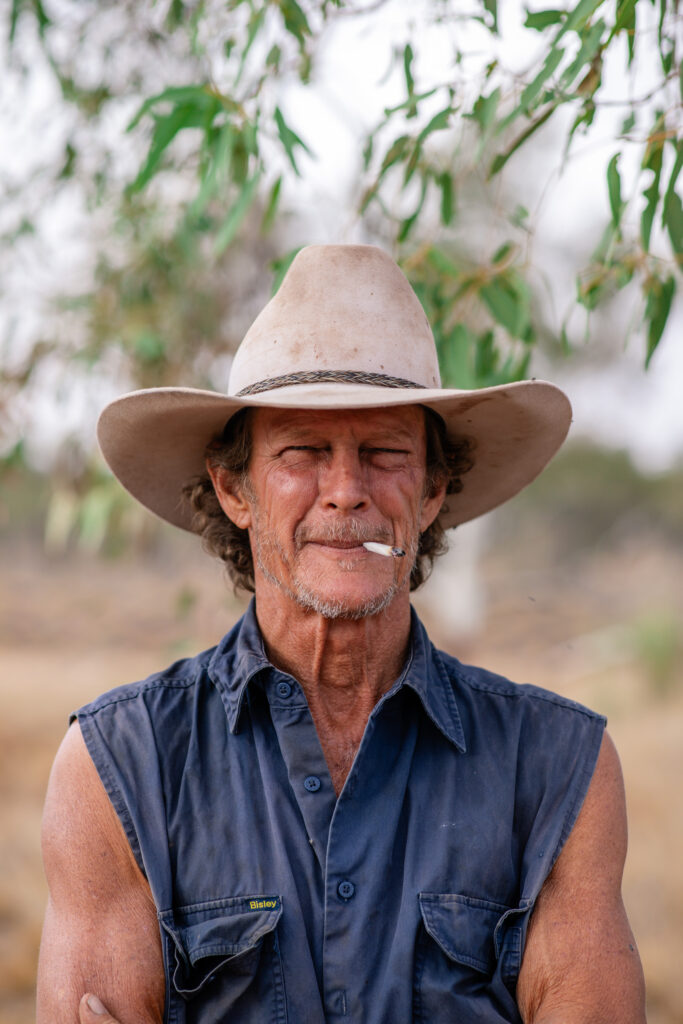 David Bird is a fourth-generation pastoralist who has spent his life learning to read the country at Indiana Station, in Central Australia. For him, running a station in the desert comes down to understanding what the land can provide, preparing for what nature might throw at you and making the most of the opportunities that come along.
His family’s history on the land stretches back generations, beginning with a story about his great-grandmother and the legendary pastoralist Sir Sidney Kidman.
“Well, I heard a story that Sid went past the deep well once when my great-grandmother was there on her own, and she had to operate the whip, and he didn’t say anything. That was his nature.”
The whip was an old method of drawing water from a well, using a horse to pull a bucket to the surface. Some-time after seeing David’s great-grandmother doing the work alone, Kidman sent a crew with a new windmill.
“But that was just one of the stories I heard about what Sid Kidman was actually like. There’s a lot of stories about old Sid.”
David says Kidman was known for being “hard but fair”, looking after people who did their jobs and treated others well. He also had little patience for waste.
“Don’t waste anything because there’s not much out here to waste. What you got, you got to get everything out of.”
It was a principle that would remain relevant throughout David’s own life on the land.
After David’s great-grandfather became ill and went south, his great-grandmother returned with the children and took up a lease at Wooler Downs, now known as Mount Skinner.
The family had to move their sheep on foot through the desert, travelling with limited equipment and no certainty about how long the journey would take.
“They walked the sheep on foot from there to Mount Skinner/Wooler Downs. And that was a pretty serious sort of a job, going through the sand hills and just everything on foot.”
They had a wagon, a couple of horses and around 600 sheep to move, with dogs taking some of the flock along the way. It was a substantial undertaking for a woman travelling with children in an isolated landscape.
“That’s a ballsy move,” David says.
He reflects on the determination of the people who established pastoral properties in the region, often without the roads, machinery and conveniences that would make life easier today.
“There was nothing. You had to have your wits about you. But why they did it, I have no idea.”
He is grateful they did.
“I’m glad they did because that’s why I’m here.”
His family’s connection to the country continued through his grandmother Pearl, who grew up at Wooler Downs before eventually making her way to Bushy Park.
David’s own connection to that history became unexpectedly tangible one day when he decided to look for the old Bushy Park homestead, a place he had never visited.
“I was heading to town one day, and I thought, a bit of spare time, stuff it, I’m just going to go over, how do I get to this old homestead?”
He travelled along the access road before turning off through the scrub and crossing a watercourse. There, unexpectedly, he found the remains of the homestead.
“Never been there in my life. I don’t know if there’s some sort of superstitious connection there. It just freaked me out though. I just felt like going to have a look and there it was.”
Only a concrete slab and scattered remnants remained, but the experience stayed with him.
In the 1940s, David’s grandfather sold Bushy Park and bought farming land in South Australia. The move did not last. David’s father and uncles eventually returned to Central Australia, where they took up a grazing lease called Indiana.
The country was known to have potential, but water was a significant problem. Previous drilling had produced little, and there was no reliable water supply to support a cattle operation.
“They knew it was good country, but you’ve got to have water too.”
The family decided to give it a go. Their first successful bore became an important part of the property’s development, and the station gradually grew from there.
David grew up on Indiana in the 1970s, when cattle work meant long days on horseback and moving stock across the country on foot. His father had four daughters and David, and the children were regularly involved in station life.
“Just on a horse as soon as before you could walk, and you’re just one of the crew.”
Flying also became part of David’s childhood. His father used a helicopter for mustering, and David would climb aboard to help spot cattle from the air. He quickly developed a preference for the view from above.
“I reckon that was the best thing (being in the helicopter), stuff the horses.”
It was the beginning of a lifelong interest in aviation. David’s own flying started in a powered hang glider, known as a trike, which he used for mustering. The aircraft was useful, but the rough air over the station could make it difficult to control, and David became concerned about the strain the conditions were putting on it.
After about 18 months, he decided to try something different. He tracked down a flying instructor in Tennant Creek who had a couple of second-hand gyrocopters and went to learn to fly one.
His instructor wasted little time getting him accustomed to the realities of flying. On David’s first attempt at landing, he cut the power, forcing him to bring the machine down without it.
That was an important lesson. A gyrocopter can land without engine power, and when flying low over country, there is little time to choose where to put it down. You have to use what is available.
The gyrocopter suited the work. Its open frame gave David a clear view of the country, and it could fly low and close to the cattle.
For David, the point was to be close enough to do the job.
“Well, that’s where the job is, on the ground. So, no point being up there if your job’s down here.”
For David, the effectiveness of an aircraft has as much to do with the person flying it as the machine itself. Years of working cattle had taught him how to read their behaviour, anticipate where they would move and understand what pressure to apply. Those skills mattered whether he was on a horse or in the air.
“99 percent of handling cattle is cattle sense, no matter what you own, with a motorbike, horse, helicopter.”
The gyrocopter became a practical tool for working the station, but it also demanded respect. David has had his share of what he calls “unscheduled landings”, and he takes responsibility for the mishaps rather than blaming the machine.
“All pilot error. You can’t blame the machine, no matter what it is. The machine won’t move if you’re not moving it.”
He has smashed gyrocopters to pieces twice, replacing rotor blades on numerous occasions. Remarkably, his flying accidents have resulted in very few injuries. He once broke his thumb trying to get his helmet off, but otherwise came away without serious harm.
“I reckon still to this day, reckon it’s the best machine ever to leave the ground. It’s the safest aircraft to leave the ground because I smashed it to pieces twice.”
That confidence is not the same as complacency. David understands how quickly a small mechanical failure can become a serious problem, particularly when flying low over rugged country. The gyrocopters are mechanically simple, but there are still components that can fail.
He once considered what might happen if the connection between the control stick and the rotors broke. Rather than leave it to chance, he taught himself to reach behind his seat and operate the control rods directly, moving the rotors without the joystick.
He thought he had a useful backup plan. Then the joystick actually broke.
On that occasion, David had been working cattle in a creek among the gum trees. After trying to get an animal moving, he headed towards a road to pick up some fuel. As he pulled back to land, the stick broke in his hand. He did not have time to reach behind him and take control of the rotors, and the aircraft hit the ground.
The preparation had not saved him that time, but the episode says something about David’s approach to flying and station work more broadly. He likes to understand how things work, think through what could go wrong and be prepared to deal with it himself.
Flying also gave David a different perspective on the landscape. After years of looking down over the same country, he began noticing patterns in where particular trees grew. He paid attention to the distribution of orange trees and developed a theory that their roots were following fault lines in the bedrock, where underground water could be found.
“I started using them to track water and I figured out that they must be tapping into the fault lines in the bedrock.”
David has used the trees to guide him towards possible drilling locations for around a decade. Finding the water is not always straightforward, because underground sources can be difficult to hit. But years of flying over the property have given him an additional way to read the country and identify places worth investigating.
“It’s just reading the country and understanding what you’re doing. You just got to have faith that there is actually water there and you’re going to have to hit it eventually.”
For David, this is part of the value of spending so much time in the landscape. The more familiar he becomes with it, the more he notices. Flying is not just a way to get around the station; it has helped him understand what lies beneath the surface.
The introduction of helicopters made mustering more efficient, but horses remained central to the work. Cattle numbers had increased following several wet seasons, and the family had to manage large mobs across a vast area.
The conditions could be challenging. Cattle prices were sometimes so low that getting them to market cost more than they were worth, while abundant grass and water allowed numbers to grow beyond what could easily be managed.
David remembers the 1970s as a time of extremes.
“Now, Mother Nature has no idea what moderation means. You see the everything or nothing.”
For him, the difficulties did not end when the rain arrived. Wet years brought damaged roads, broken fences and the threat of major fires as the grass dried out.
“I’d rather a dry spell in this country than a big rain, because it’s so much easier.”
He explains that the work after a big season can be relentless. Roads and fences need repairing, cattle must be mustered, and preparations for fires begin months before the danger arrives.
“You’ve got to stay on top of it, because if you relax, you get that far behind. You’ve just got to stay in front, read what’s coming and prepare.”
When David’s father died, the future of Indiana became a question of family, finances and responsibility.
His father had wanted the children to have an equal share, but the family accountant explained the difficulties that could arise from that arrangement. David was determined not to give up the property, despite the substantial debt involved.
“I said, no, we’re talking about me home here, I’m not going to give it up without a crack.”
He had no formal business experience, but he knew the station and understood how to run cattle in the desert. Rather than sell, he committed to paying off the debt of buying his siblings shares, and keeping expenses to a minimum.
“I said, I lived out there, I know how to grow cows out in the desert, that’s all I need to know.”
For eight years, he kept the operation lean, using second-hand equipment and focusing on the essentials: pumping water, selling cattle and maintaining the property.
He had little interest in spending money on improvements until he owned the station outright.
“I just, you know, run on the smell of an oily rag for eight years until I paid that last cent off, and then told the bank to go and shove it.”
Once the debt was cleared, he began developing more of the property, particularly its water infrastructure. He also made a conscious decision to structure the operation so it could run without employees.
His approach was shaped by the need to keep costs down, but it also reflected his preference for working independently and making decisions himself.
David’s wife, Liz, has played an important role in the business. While he concentrates on the practical side of running the station, she handles the paperwork and computer work.
“I do the easy shit. I grow the cow. Well, I watch cows grow, I don’t grow them. They grow themselves, so my part’s easy. Liz does all the hard work.”
The couple have built their life around a shared understanding of their different roles and the demands of station life.
“We don’t try to change each other. When she can, she does her own thing.”
David has no desire to leave the station, while Liz enjoys travel. He says the key is allowing each other to pursue their own interests without trying to change the other person.
“And we are a good team. I think we do a pretty good job together. Because what I’m doing, I couldn’t do without her.”
David’s approach to managing Indiana is based on accepting the limitations of the environment. He does not believe the country is suited to high-intensity development, and he has chosen not to increase cattle numbers simply because more water points could potentially be installed.
“The land type and the climate is not conducive to high intensity anything.”
Instead, he aims to run cattle at a level the country can support, leaving room to respond when conditions change. That approach also protects the business from circumstances beyond his control, including the possibility of being unable to sell cattle.
“One reason why I never have it at capacity, because if another idiot like Gillard comes along and shuts the industry down, I’m stuck with all these cattle I can’t get rid of.”
He sees preparation as more useful than trying to control the uncontrollable. Nature will dictate the conditions, but careful management can help prevent a difficult season from becoming a disaster.
His father faced repeated setbacks during his years on the station, including drought, low cattle prices and rising interest rates. David believes his own experience has been easier in some respects, partly because he has been able to anticipate the challenges that come with living in a desert.
“Nature government, she’s my boss. As long as you respect that, you’re not going to get caught.”
In more recent years, David has found another challenge away from station work: off-road racing. After becoming seriously ill in 2016, he bought a race vehicle and began pursuing a long-held interest in machinery and speed.
He describes racing as an opportunity to do something completely different, away from the responsibilities of running the property.
“You just go down there like a big kid in a sandpit with a toy that you want to wreck. And you just let loose and then you come home and think that was good fun.”
For someone whose working life has involved keeping machinery running and making every resource count, racing offers a different kind of freedom.
After more than 50 years on Indiana, David says there is little he would change about his life. Flying remains one of the things he enjoys, but it is also a practical part of the way he works and understands the country.
He does not describe his life as extraordinary. He values the opportunities he has taken and the ability to remain on the land where he was born.
“I wouldn’t swap it for anything in the world.”
Asked what he has learned over the course of his life, he offers a straightforward answer.
“Live it.”
He believes opportunities should be taken when they arise, rather than waiting for someone else to create the life you want.
“You only get one shot at it.”
For David, the lesson is much like flying a single-seat aircraft. You are responsible for your own direction, and you need to understand your options before you find yourself in a difficult position.
“Be responsible for your destination. Because you’re the only one on the steering wheel, the same as flying. You’re the only one who can take you to where you want to go when you’re in a single seat machine on your own.”
It is a philosophy shaped by family history, decades of working in a demanding environment and a deep familiarity with the country around him.
There may be little certainty in the seasons, but David has found his own way to live with that uncertainty: understand the land, prepare for what might come, take the opportunities available and make the most of what you have.
“There’s no secrets. It’s just common sense.”